Psychological Safety: What It Really Is, and Why It Matters More Than Ever
Psychological safety isn't about comfort or lowering the bar — it's the shared belief that you can speak up, ask, or admit a mistake without being punished. Three decades of research show why it's the hidden engine behind team learning and performance.
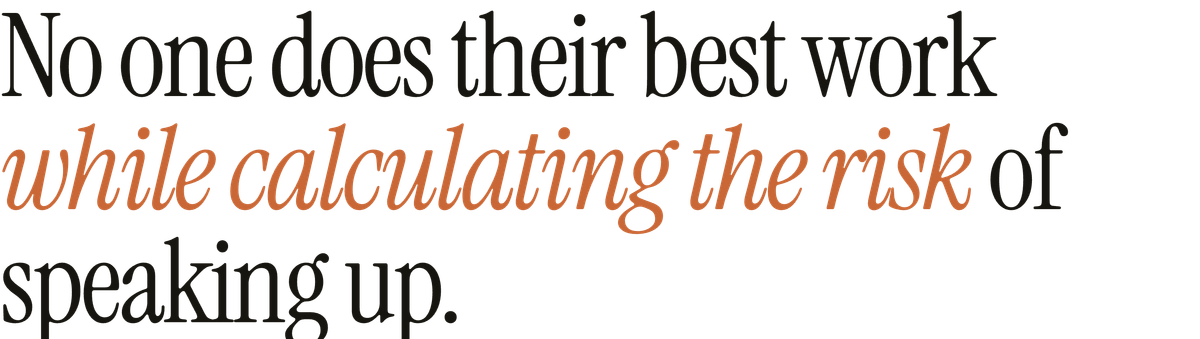
Think back to the last time you were in a meeting and something didn't sit right with you. Maybe a plan had an obvious flaw, maybe you didn't understand a decision everyone else seemed to accept, or maybe you had a half-formed idea that could have improved the outcome. Did you speak up? Or did you run a quick, silent calculation — Will I look incompetent? Will I annoy my boss? Is it worth the risk? — and decide to keep quiet?
That split-second calculation happens in workplaces millions of times a day, and its outcome shapes almost everything that matters: whether errors get caught, whether good ideas surface, whether teams learn, and ultimately whether organizations adapt or fall behind. The concept that explains this dynamic is psychological safety, and after three decades of research it has moved from an academic niche to one of the most consequential ideas in management. This post explains what psychological safety actually is, where the idea came from, and — drawing on a body of rigorous studies — why it deserves a place at the top of any leader's agenda.
What Psychological Safety Is (and What It Is Not)
Psychological safety is the shared belief that a team or workplace is safe for interpersonal risk-taking — that you can ask a question, admit a mistake, raise a concern, or propose a wild idea without being punished, humiliated, or thought less of. As Amy Edmondson and Derrick Bransby put it in their 2023 review of the field, it describes "a work environment where people believe that such candor is expected and possible." At its core, it is a state of reduced interpersonal risk.
It is just as important to be clear about what psychological safety is not. It is not about being nice, lowering standards, or shielding people from hard feedback. It is not a synonym for comfort, cohesion, or friendship. And it is emphatically not the opposite of accountability. In fact, the most productive environments combine high psychological safety with high standards: people feel safe enough to be candid and are expected to perform. A team where everyone is comfortable but no one is challenged is not psychologically safe — it is simply complacent. Psychological safety is what makes it possible to hold people to a high bar without silencing them in the process.
Another common misunderstanding is that psychological safety is an individual personality trait — that some people are just braver than others. While personality plays a role, the research is clear that psychological safety is primarily a property of the environment. The same person will speak up freely on one team and go quiet on another. That is a hopeful finding, because it means psychological safety is something leaders and teams can deliberately build, not a fixed trait they are stuck with.
Where the Idea Came From
The term is not new. Psychological safety was introduced to the organizational sciences half a century ago by Edgar Schein and Warren Bennis in 1965, who saw it as a condition that helped people cope with the anxiety of change. In 1990, William Kahn connected it to employee engagement, arguing that people bring their full selves to work only when they feel safe to do so.
But the idea's modern renaissance began with Amy Edmondson's research in the late 1990s, which shifted the focus to teams and, crucially, to learning. Edmondson noticed something counterintuitive in hospital data: the best-performing units seemed to report more errors, not fewer. The explanation was not that better teams made more mistakes — it was that they felt safe enough to discuss and report them, and therefore to learn from them. That insight reframed psychological safety as the hidden engine behind a team's ability to learn, adapt, and improve. Since then, the field has exploded. Edmondson and Bransby's 2023 review identified 185 empirical articles published in just nine years, and they group the accumulated findings into four dominant themes: getting things done, learning behaviors, improving the work experience, and leadership.
Why It Matters: What the Evidence Actually Shows
It is one thing to argue that psychological safety feels important; it is another to show it moves the needle on outcomes organizations care about. Here the most comprehensive evidence comes from a large meta-analysis by Lance Frazier and colleagues, published in Personnel Psychology. They pooled 136 independent samples representing more than 22,000 individuals and nearly 5,000 groups — a scale that lets us move past any single study's quirks and see the broad pattern.
The results are striking. Psychological safety is consistently and positively related to the outcomes that matter most: employee engagement, task performance, job satisfaction, and organizational commitment. Its relationship with information sharing and learning behavior is especially strong — which is exactly what Edmondson's original theory predicted, and, as the authors note, "at the very core of why the construct has maintained the high level of research attention over the years." Psychological safety showed a more moderate link to organizational citizenship behavior (going above and beyond your formal role) and a weaker link to creativity. Importantly, the meta-analysis found that psychological safety predicts performance over and above related factors like good leader relations and work engagement — meaning it contributes something unique, not just a repackaging of "employees who like their jobs."
The same analysis tells us where psychological safety comes from. The strongest and most consistent drivers fall into three categories. First, relationships with leaders matter enormously: transformational leadership (a correlation of roughly .42) and inclusive leadership (around .36) were both strong predictors, underscoring how much the direct manager shapes whether candor feels safe. Second, work design matters — and here interdependence (work that requires people to rely on one another) showed the strongest effect of all, because when people genuinely need each other, the climate for speaking up becomes central. Third, a supportive work context, especially peer support, made a significant difference. Individual personality played a smaller but real role: proactive people and those with a learning orientation felt more psychologically safe, while — interestingly — openness to experience did not predict it, perhaps because open-minded people speak up regardless of the climate. The headline is clear: psychological safety is built far more by context, leadership, and how work is structured than by who happens to be on the team.
It Is Built — or Broken — by Leaders
If psychological safety is a property of the environment, then leaders are its chief architects. Edmondson's classic study of sixteen cardiac surgery teams learning a demanding new operating technology showed this vividly. The technology was identical across hospitals, yet some teams mastered it quickly while others struggled. The difference was not raw talent or resources — it was how leaders behaved. The teams that succeeded had leaders who actively coached, made it easy to speak up, and spanned boundaries to bring in information. The most effective surgeons did two things in particular: they communicated a motivating rationale for the change, and they deliberately minimized concerns about power and status differences so that a nurse or technician would feel able to flag a problem to a senior surgeon mid-operation. In a setting where a moment of silence can cost a life, that willingness to speak became a matter of survival.
Ingrid Nembhard and Amy Edmondson gave this leadership behavior a name: leader inclusiveness — "words and deeds exhibited by leaders that invite and appreciate others' contributions." Studying 23 neonatal intensive care units, they found that professional status shapes how safe people feel (higher-status professionals like physicians feel safer than lower-status nurses or respiratory therapists), but that leader inclusiveness helps counteract those status barriers. When leaders explicitly invite input and show they value it, the gap between high- and low-status team members narrows, psychological safety rises, and people become more willing to engage in the messy, collaborative work of quality improvement. In other words, inclusive leaders can partially dissolve the very hierarchies that normally keep people quiet.
It Crosses Status Lines — and Team Boundaries
The role of status shows up again in a fascinating study by Nadine Bienefeld and Gudela Grote of 1,490 aircrew members at a European airline. Speaking up in aviation is not a nicety — it is a defense against catastrophe. The researchers found that a crew member's sense of psychological safety was the mechanism that translated both their status and their leader's inclusiveness into actually speaking up within their team. And they uncovered something subtle about how safety travels across team boundaries: when crews had to coordinate across different teams (for example, cabin crew and cockpit), it was people's within-team sense of safety that gave them the confidence to raise concerns across the divide. Their well-functioning home team acted, in the authors' phrase, as a "safe harbour" — a secure base from which members could take the risk of speaking up in less familiar territory. Psychological safety, it turns out, is not just something you feel in a single room; it is portable, and a strong home team helps people carry it with them.
It Is Essential for Diverse Teams to Thrive
Some of the most important recent work connects psychological safety to diversity — and to why diverse teams sometimes soar and sometimes stumble. Erica Foldy, Peter Rivard, and Tamara Buckley argue that power inequities drive the dynamics of racially diverse teams, often producing conflict, withdrawal, or assimilation, all of which choke off learning. Their prescription centers on identity safety: the belief that you are safe despite — and indeed with — your racial or cultural identity, paired with a genuine stance that treats different identities and viewpoints as resources for the work rather than problems to be managed. Only by attending honestly to power dynamics, they contend, can groups establish the psychological safety that learning across difference requires.
The stakes of getting this right are captured in a two-year study by Robin Ely, Irene Padavic, and David Thomas of 496 retail bank branches. They found that diversity is neither automatically an asset nor a liability — its effect depends entirely on the team's learning environment. Where minority team members had negative assessments of that environment, diversity was linked to worse performance, regardless of what their White colleagues thought. Only when both groups experienced the learning environment as supportive — a sign the team had successfully countered the drag of societal stereotypes on cross-race interaction — did diversity translate into better bottom-line performance. The lesson is sobering and practical: you cannot capture the value of a diverse team simply by assembling one. You have to build the psychologically safe, learning-oriented environment that lets differences become an advantage rather than a fault line.
It Matters at the Top, Too
It would be a mistake to think psychological safety is only for frontline crews and operating rooms. A recent study by Emil Mogård, Ole Rørstad, and Henning Bang of 1,150 leaders across 160 Norwegian management teams found that psychological safety improves the effectiveness of senior teams as well — and it explained how. The effect flows through behavioral integration: when team members feel safe to speak their minds without fear of repercussions, they collaborate more, share more information, and take joint ownership of decisions, and that integrated way of working is what makes the team perform. Even in the C-suite — perhaps especially there, where the cost of an unchallenged bad decision is highest — the willingness to be candid is a competitive asset.
How to Build It
Across all of this research, a consistent and encouraging picture emerges. Psychological safety is learnable and buildable, and leaders have outsized influence over it. A few evidence-based practices stand out. Leaders should frame work as a learning problem rather than an execution problem, acknowledging that in complex, uncertain conditions no one has all the answers. They should model fallibility by admitting their own mistakes and the limits of their knowledge, which signals that others can do the same. They should actively invite input — asking genuine questions and, crucially, responding to contributions with appreciation rather than dismissal, the behavior Nembhard and Edmondson call leader inclusiveness. They should deliberately flatten the status cues that silence lower-status members, as the best surgeons did. And they should pair candor with high standards, making clear that speaking up is expected precisely because the work is important.
Why It Matters More Than Ever
The reason psychological safety has "come of age," as Edmondson and Bransby title their review, is that the nature of work has changed. Today's organizations face greater uncertainty, complexity, and interdependence than ever before — a reality sharpened by a global pandemic that threw markets, operations, and staffing into flux. When work was routine and predictable, an organization could get by on people quietly executing well-defined tasks. When work is uncertain and interconnected, the ability to learn in real time — to surface problems early, question assumptions, integrate diverse perspectives, and adapt — becomes the decisive capability. And that ability rests entirely on whether people feel safe enough to contribute their knowledge candidly and in the moment.
That is the deepest reason psychological safety matters. It is not a soft perk or a matter of workplace comfort. It is the condition under which a group of talented people actually becomes a learning, high-performing team rather than a collection of individuals each silently running that split-second calculation and, too often, deciding to stay quiet. The evidence — from operating rooms and cockpits to bank branches and boardrooms — points in the same direction: build the safety, and you unlock the learning; unlock the learning, and you unlock the performance.
Sources
- Edmondson, A. C., & Bransby, D. P. (2023). Psychological Safety Comes of Age: Observed Themes in an Established Literature. Annual Review of Organizational Psychology and Organizational Behavior, 10, 55–78.
- Frazier, M. L., Fainshmidt, S., Klinger, R. L., Pezeshkan, A., & Vracheva, V. (2017). Psychological Safety: A Meta-Analytic Review and Extension. Personnel Psychology, 70, 113–165.
- Edmondson, A. C. (2003). Speaking Up in the Operating Room: How Team Leaders Promote Learning in Interdisciplinary Action Teams. Journal of Management Studies, 40(6).
- Nembhard, I. M., & Edmondson, A. C. (2006). Making It Safe: The Effects of Leader Inclusiveness and Professional Status on Psychological Safety and Improvement Efforts in Health Care Teams. Journal of Organizational Behavior, 27, 941–966.
- Bienefeld, N., & Grote, G. (2014). Speaking Up in Ad Hoc Multiteam Systems: Individual-Level Effects of Psychological Safety, Status, and Leadership Within and Across Teams. European Journal of Work and Organizational Psychology, 23(6), 930–945.
- Foldy, E. G., Rivard, P., & Buckley, T. R. (2009). Power, Safety, and Learning in Racially Diverse Groups. Academy of Management Learning & Education, 8(1), 25–41.
- Ely, R. J., Padavic, I., & Thomas, D. A. (2012). Racial Diversity, Racial Asymmetries, and Team Learning Environment: Effects on Performance. Organization Studies, 33(3), 341–362.
- Mogård, E. V., Rørstad, O. B., & Bang, H. (2023). The Relationship between Psychological Safety and Management Team Effectiveness: The Mediating Role of Behavioral Integration. International Journal of Environmental Research and Public Health, 20, 406.